
STEM Career Pathways
A collection of resources including mentoring and role models, fostering STEM identity and belonging, STEM workforce, and annual events.
To ensure a vibrant science, technology, engineering, and mathematics (STEM) workforce, we need to create pathways and opportunities for STEM learning for both children and adults.
A person’s path into a STEM career is shaped by far more than just formal school coursework and technical training. Pathways are influenced by hands-on STEM experiences, awareness of career possibilities, interacting with STEM professionals, developing a sense of STEM identity, and feeling a strong sense of belonging in STEM spaces.

STEM Career Pathways
A STEM career pathway shows the different ways people can explore and learn about science, technology, engineering, and math in school and in the community. These experiences can build skills people use throughout their lives, and for some, they may lead to a STEM degree or career. Unlike the old idea of a “pipeline,” which imagines one narrow path, pathways recognize that people can take many routes and enter or re-enter STEM at different points.
Resources
- NISE Network STEM Learning Ecosystems resources
https://www.nisenet.org/stem-learning-ecosystems
Annual Events
- National Mentoring Month (January)
- MENTOR National STEM mentoring resources
https://www.mentoring.org/campaigns/stem-mentoring-month/ - NISE Network guide Working with STEM Experts: A Guide for Educators in Museums and Other Informal Learning Settings
https://www.nisenet.org/working-with-experts - National Girls Collaborative Project role model and mentoring resources
https://ngcproject.org/resources/role-model-and-mentoring-resources - SciGirls Role Model Strategies
https://ny.pbslearningmedia.org/collection/scigirls/ - National Academies Science of Effective Mentorship in STEMM
https://nap.nationalacademies.org/resource/25568/interactive/
- MENTOR National STEM mentoring resources

- Engineers Week (Third week in February)
- DiscoverE https://discovere.org/engage/engineers-week/
- NISE Network engineering resources https://www.nisenet.org/engineering
- Introduce a Girl to Engineering Day (During third week in February)
- https://discovere.org/programs/girl-day/
- NISE Network compilation of resources for engaging girls and young women in STEM https://nisenet.org/girls
- NISE Network engineering resources https://www.nisenet.org/engineering

- Take a Child to Work Day / Bring a Kid to Work Day /
Take Our Daughters and Sons to Work Day (third Thursday in April)- Take A Child to Work Day and Beyond https://tacw.ja.org/
- Department of Interior activities and career profiles https://www.doi.gov/pmb/hr/kids-to-work-day
- https://www.brighthorizons.com/resources/article/bring-your-child-to-work-day
- National Apprenticeship Week (last week in April)
- National Intern Day (Last Thursday of July)
- Career Days at local schools and community programs (vary)
Mentoring and Role Model Resources
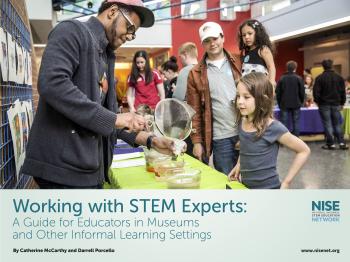
- MENTOR National STEM mentoring resources
https://www.mentoring.org/campaigns/stem-mentoring-month/ - National Girls Collaborative Project role model and mentoring resources
https://ngcproject.org/resources/role-model-and-mentoring-resources - SciGirls Role Model Strategies
https://ny.pbslearningmedia.org/collection/scigirls/ - National Academies Science of Effective Mentorship in STEMM
https://nap.nationalacademies.org/resource/25568/interactive/ - National Intern Day resources
https://www.nationalinternday.com/ - NISE Network guide Working with STEM Experts:
A Guide for Educators in Museums and Other Informal Learning Settings
https://www.nisenet.org/working-with-experts
STEM Identity and Belonging

STEM identity refers to how people think about themselves as science learners and how they develop an identity as someone who knows about, uses, and sometimes contributes to science.
A strong STEM identity is one of the best predictors of whether someone will:
- Persist in STEM learning, even when it becomes challenging
- Seek out additional learning opportunities
- Pursue STEM pathways in school, careers, or lifelong learning
- Feel a sense of belonging in STEM spaces (such as classrooms, clubs, or programs)
- See STEM as relevant to their lives, communities, and future
STEM Identity Resources
- Bell, J., Besley, J., Cannady, M., Crowley, K., Grack Nelson, A., Philips, T., Riedinger, K., & Storksdieck, M.(2018). The Role of Identity in STEM Learning and Science Communication: Reflections on Interviews from the Field. Washington, DC: Center for Advancement of Informal Science Education.
https://informalscience.org/identity/ - Dou, R., Villa, N., Cian, H., Sunbury, S., Sadler, P. M., & Sonnert, G. (2025). Unlocking STEM Identities Through Family Conversations About Topics in and Beyond STEM: The Contributions of Family Communication Patterns. Behavioral Sciences, 15(2), 106. https://doi.org/10.3390/bs15020106
- Archer, L., Moote, J., MacLeod, E., Francis, B., & DeWitt, J. (2020). ASPIRES 2: Young people’s science
and career aspirations, age 10-19. London: UCL Institute of Education.
https://www.ucl.ac.uk/ioe/departments-and-centres/education-practice-and-society/research/aspires-research - Sonnert, Gerhard & Reid, Tingting & Sunbury, Susan & Sadler, Philip. (2025). How do formal and informal science learning experiences during high school shape students’ career interest and STEM identity?. International Journal of STEM Education. 12. 10.1186/s40594-025-00568-w.
https://doi.org/10.1186/s40594-025-00568-w
Belonging Resources
- Othering and Belonging Institute at UC Berkeley
https://belonging.berkeley.edu/
STEM Workforce, Career, and Career and Technical Education (CTE) Resources
- AAAS STEMM Opportunity Alliance
- https://stemmopportunity.org/
- Connecting Learning to Careers https://stemmopportunity.org/fieldguide
- Apprenticeship USA
https://www.apprenticeship.gov/ - Jobs for the Future
https://www.jff.org/ - Project Lead the Way
https://www.pltw.org/ - Science is US
https://scienceisus.org/ - Science at Work: The People and Industries Powering America’s Prosperity report
https://scienceisus.org/science-at-work/ - STEM NEXT
- Five Ways for Families to Connect Youth to Careers: Elementary School
https://stemnext.org/5-ways-to-connect-youth-to-careers/ - Helping Youth See What’s Possible: A New Framework for Career-Connected Learning Beyond the Classroom
https://stemnext.org/career-connected-learning-framework/ - Strengthening Career-Connected Learning: The Building Bridges with Industry Playbook
https://stemnext.org/building-bridges-with-industry-playbook/
- Five Ways for Families to Connect Youth to Careers: Elementary School
- STEM Classroom to Career: Opportunities to Close the Gap
https://www.napequity.org/nape-content/uploads/STEM-Classroom-to-Career-report-FINAL.pdf - Vision for American Science & Technology (VAST)
https://www.vastfuture.org/
Workforce reports
- Institute of Education Sciences Career and Technical Education (CTE)
https://ies.ed.gov/career-and-technical-education - National Academy of Engineering. 2018. Understanding the Educational and Career Pathways of Engineers. Washington, DC: The National Academies Press. https://doi.org/10.17226/25284
https://nap.nationalacademies.org/catalog/25284/understanding-the-educational-and-career-pathways-of-engineers - National Academies of Sciences, Engineering, and Medicine (NASEM) - Board on Higher Education and Workforce
https://nap.nationalacademies.org/author/BHEW/policy-and-global-affairs/board-on-higher-education-and-workforce - National Science Foundation - Science & Engineering Indicators
https://ncses.nsf.gov/indicators - STEM Ed Coalition Fact Sheets - The Case for STEM Education as a National Priority: Good Jobs and American Competitiveness
https://www.stemedcoalition.org/policyissues - Science & Technology Action Committee - The State of Science Science in America
https://sciencetechaction.org/the-state-of-science-in-america/ - State of the U.S. Semiconductor Industry
https://www.semiconductors.org/wp-content/uploads/2025/07/SIA-State-of-the-Industry-Report-2025.pdf
Career Profiles and Preparation
U.S. Department of Labor
- O*NET Interest Profiler https://onetinterestprofiler.org/
- Occupation requirements and skills https://www.onetonline.org
My Next Move https://www.mynextmove.org/