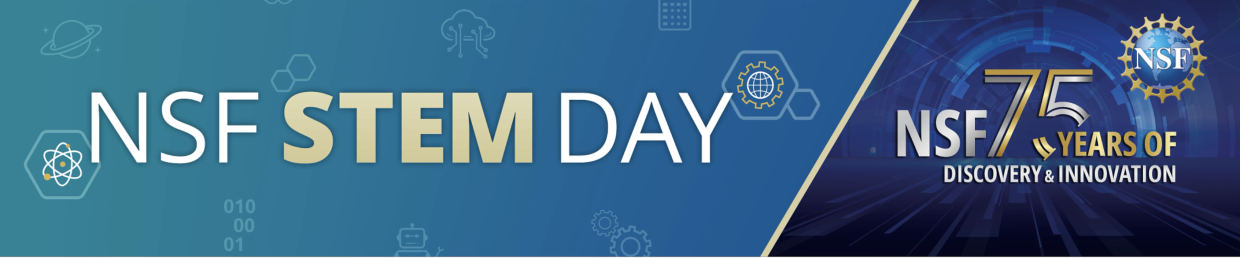
Since 1950, the U.S. National Science Foundation (NSF) has invested in ideas and innovations across all fields of science and engineering. As an independent federal agency established to promote the progress of science and advance national health, prosperity, and welfare, the NSF has supported science and engineering in all 50 states and U.S. territories for the past 75 years. NSF-funded research has driven economic growth and positively impacted countless lives.
To celebrate 75 years of research, innovation, and public engagement in STEM, NSF STEM Day will be held on May 10, 2025. This nationwide day of outreach and learning will feature activities and events that highlight NSF-supported research. Museums, science centers, and research facilities across the country will participate, offering both in-person and virtual events where the public can learn about and engage with science.
This celebration aims to inspire public interest in STEM by showcasing the lasting impact of the National Science Foundation's investments in innovation and informal STEM learning. Through a wide range of engaging experiences and accessible learning environments, NSF STEM Day will promote lifelong learning and greater public participation in science.
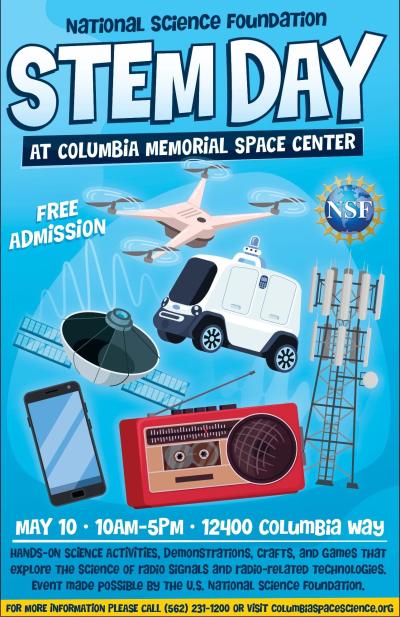
Making Waves with Radio event at Columbia Memorial Space Center in Downey, CA
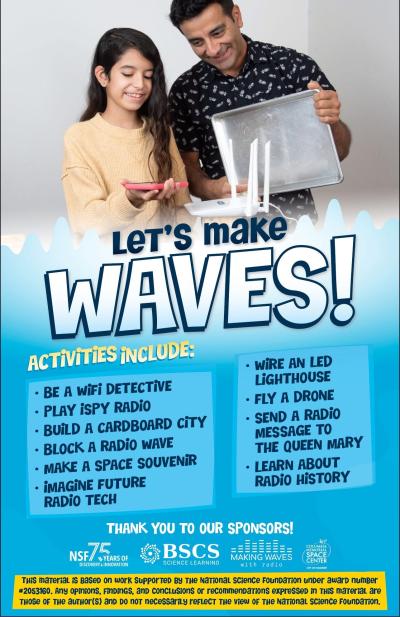
Many NISE Network partners will be hosting events this May 10th, including our partners at BSCS Science Learning & Columbia Memorial Space Center in Downey, California. BSCS, based in Colorado Springs, led the NSF-funded project (Grant No. DRL 2053160) Making Waves with Radio. Hands-on activities from the NISE Network's Making Waves with Radio Kit, developed with NISE Network partners Children's Creativity Museum in San Francisco, CA, Sciencenter in Ithaca, NY, and the Museum of Life and Science in Durham, NC, will be central in the festivities, along with radio tech demonstrations and making activities. All Making Waves with Radio educational materials and guides were developed and evaluated through the funding provided by NSF.
NSF-funded projects from the NISE Network
The NISE Network is incredibly grateful to NSF, whose generous support initiated our work 20 years ago with a grant to create a national community of researchers and informal science educators dedicated to fostering public awareness, engagement, and understanding of nanoscale science, engineering, and technology (Award Nos. 0532536 and 0940143, 2005-2017). As we've evolve, NSF has continued to be a partner in our work, allowing us to expand our reach to a variety of STEM topics. Some of these project include: ChemAttitudes/Let's Do Chemistry (Grant No. DRL 1612482), Frankenstein200 Project (Grant No. DRL 1516684), Building with Biology (Grant No. DRL 1421179).
Learn more about the NSF 75th Anniversary
Watch a video about how NSF is transforming our world:
https://www.youtube.com/watch?v=MHI1Oo2YI1oPromotion assets:
https://mediahub.nsf.gov/portals/agilbske/NSF75thAnniversary
Ways to share your NSF stories
Share the impacts from your NSF Directorate for STEM Education (EDU) projects with NSF and other relevant organizations
More ways to share your NSF stories and impacts
Learn more about NSF impacts
The next time you talk on a cell phone, hear a weather report, search the web, or get an MRI, remember the U.S. The National Science Foundation helped make that all possible, and more.
Learn more about NSF and the NISE Network
The NISE Network’s original project funding from the National Science Foundation began in 2005, with a focus on nanoscale science and technology (Award Numbers 0532536 and 0940143).
The Nanoscale Informal Science Education Network (NISE Network) (2005-2016) included more than 600 museums, universities, and other organizations. Collectively, the network reached public audiences across the United States. Over 11 million people a year participate in NISE Network programs, events, and exhibitions. NanoDays events mobilized hundreds of NISE Network partners across the country to engage staff, volunteers, and members of the public in learning about nanoscale science, engineering, and technology. From 2008 through 2016, NanoDays events and programming reached over seven million people. Educational products included learning frameworks, exhibitions, programs, hands-on activities, presentations, films, discussion forums, graphics, publications, and professional learning resources. Emphasis was placed on local collaborations and two-way dialogue between scientists, educators, and the public.
Over the years, we have continued to evolve and grow with different partners and projects. We've explored a wide range of STEM topics, always with a commitment to enhancing our capacity to engage the public. In 2016, NISE Network transitioned to an ongoing identity as the National Informal STEM Education Network, leveraging the investment of the National Science Foundation for new projects and collaborations. After the end of the nanoscale project in 2016, the NISE Network has gone on to pursue other topics including synthetic biology, sustainability, responsible innovation, chemistry, radio science, Earth and space science, climate resilience, and neuroscience.
These large-scale collaborative efforts would not have been possible without NSF funding.
Nanoscale Informal Science Education Network impacts summaries:
Public Impacts (2016):
https://www.nisenet.org/catalog/nise-network-public-impacts-summative-evaluation-2016Professional Impacts (2016):
https://www.nisenet.org/catalog/nise-network-professional-impacts-summative-evaluation-2016Partner Report (2016)
https://www.nisenet.org/catalog/nise-network-impacts-report-partners