
DESCRIPTION
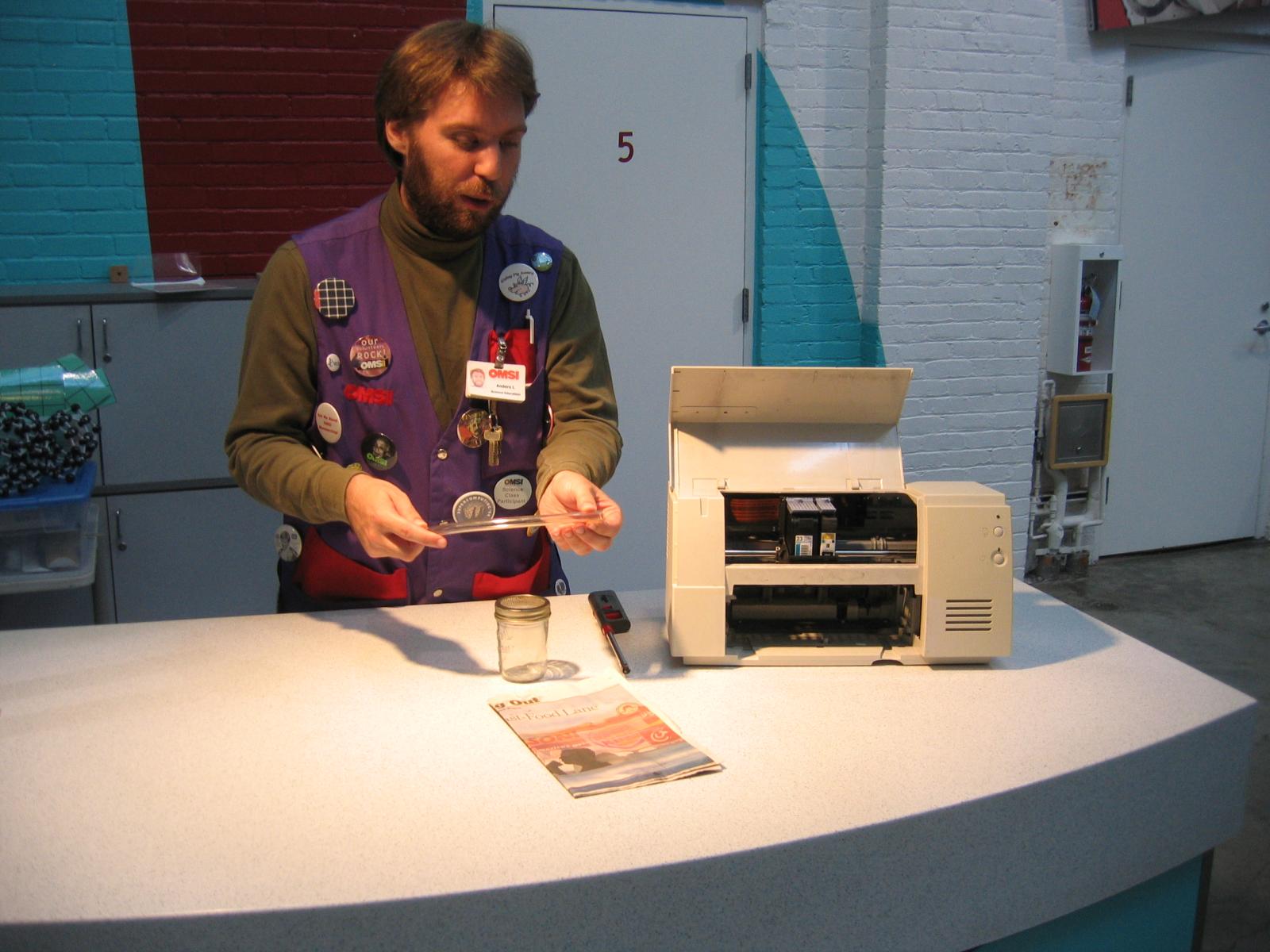
Through hands-on activities, visitors learn how inkjet printers produce tiny, precise drops of ink. They examine printed paper with magnifying glasses, see a few demonstrations of how liquids behave differently at the small scale, and see an explosive demonstration of how ink is forced out of an ink cartridge.
DESCRIPTION
Through hands-on activities, visitors learn how inkjet printers produce tiny, precise drops of ink. They examine printed paper with magnifying glasses, see a few demonstrations of how liquids behave differently at the small scale, and see an explosive demonstration of how ink is forced out of an ink cartridge.
TRAINING VIDEOS
OBJECTIVES
BIG IDEA
Inkjet printers take advantage of novel properties to print pictures and text.
LEARNING GOALS
Inkjet printers use tiny technology.
Water and ink act differently on very small scales.
Many inkjet printers boil ink to make it move.
Nanoscale effects occur in many places. Some are natural, everyday occurrences; others are the result of cutting-edge research.
NANO CONTENT MAP
Nanometer-sized things are very small, and often behave differently than larger things do.

Credits
Oregon Museum of Science and Industry
Developed for the NISE Network with funding from the National Science Foundation under Award Numbers 0532536 and 0940143. Any opinions, findings, and conclusions or recommendations expressed in this product are those of the authors and do not necessarily reflect the views of the Foundation.
Creative Commons Attribution Non-Commercial Share Alike 3.0 United States (CC BY-NC-SA 3.0 US).
View more details

NISE Network products are developed through an iterative collaborative process that includes scientific review, peer review, and visitor evaluation in accordance with an inclusive audiences approach. Products are designed to be easily edited and adapted for different audiences under a Creative Commons Attribution Non-Commercial Share Alike license. To learn more, visit our Development Process page.